A Brief Reopening Milestone
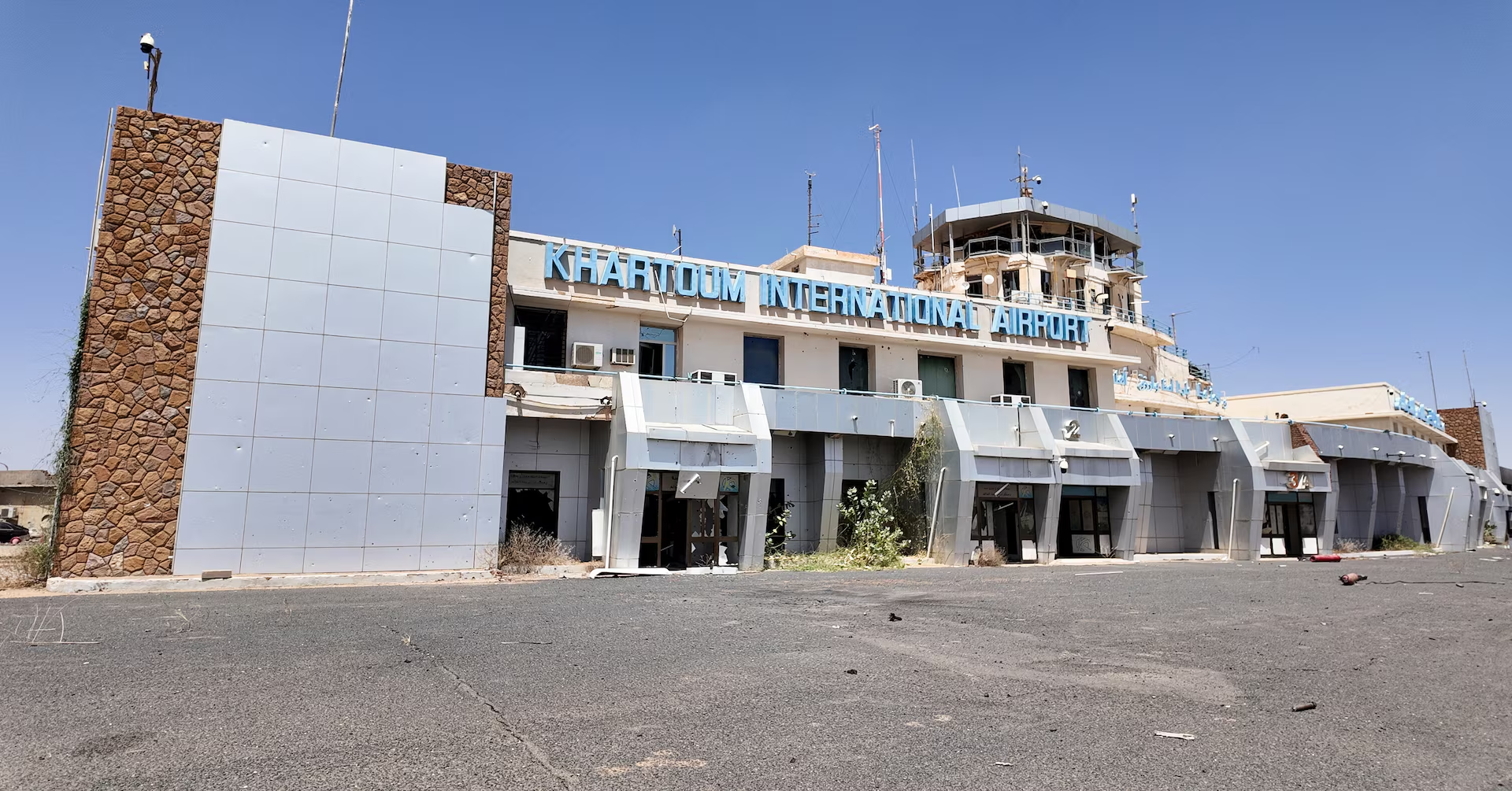
On 22 October 2025, a civilian flight by Badr Airlines landed at Khartoum International Airport for the first time in over two years, signalling a gradual resumption of air services in Sudan’s war-struck capital.
The airport had remained shut since April 2023 when the civil war between the Sudanese Armed Forces (SAF) and the Rapid Support Forces (RSF) erupted and the facility suffered heavy damage.
However, the reopening came even as the RSF launched drone strikes targeting the airport and surrounding infrastructure, underlining the fragility of the security environment.
While the initial flights are domestic only, the move has far-reaching implications. It isn’t just about airline schedules or stranded travellers—it speaks to Sudan’s broader recovery, the region’s connectivity, humanitarian supply chains, and geopolitical contestation in the Horn and wider Africa.
1. Reconnecting a Nation, Reviving Mobility
For two and a half years, Khartoum’s airport closure isolated Sudan’s capital from its usual air links. The only viable gateway for much of the country was Port Sudan International Airport on the Red Sea.
Resuming flights restores crucial internal links:
- For displaced Sudanese: Millions fled fighting and are now returning; restored air links ease travel for citizens scattered internally or abroad.
- For business and trade: Cargo and passenger movement support reconstruction efforts. Local firms, aid agencies and diaspora alike see the airport as a gateway.
- For state presence: The reopening signals that even amid conflict, Sudan’s government aims to re-establish basic infrastructure and sovereignty over space.
Thus, beyond transportation, the airport’s opening is a physical and symbolic step toward normalization.
2. Humanitarian and Reconstruction Lifeline
Sudan is in one of the worst humanitarian crises globally: millions internally displaced, millions more food insecure. The airport’s reopening matters because:
- Aid delivery: Air access allows humanitarian agencies to bring supplies into Khartoum and then distribute across Sudan. Even domestic flights can enable rapid movement of goods and personnel.
- Infrastructure rehab: Reconstruction of the airport itself required securing runways, terminals, utilities—these efforts often spur broader rehabilitation of power, water, communications networks.
- Return and reintegration: With people returning to places of origin, efficient transport assists their reintegration—be it movement of personal belongings, skills, or reinvestment in local economies.
Therefore, the airport is not simply a travel hub—it is a logistics node critical for humanitarian response and infrastructure rebuilding.
3. Economic and Regional Connectivity
Reopening Khartoum’s airport offers economic opportunities regionally and internationally:
- Domestic economic boost: Travel, commerce and cargo flows help local businesses, tourism (once safe), and employment in aviation-related services.
- Regional linkages: Sudan sits at the crossroads of East Africa, North Africa and the Middle East. Reliable air connections could revive trade corridors with Egypt, Ethiopia, Gulf states and beyond.
- Air-space revenue: As Sudan stabilises, reopening air space and routes can restore air-traffic control fees, over-flight charges and related revenue streams vital to national economics. (Observers note Sudan once earned significant fees for its airspace.)
- Foreign investment signal: A functioning major airport signals to investors that Sudan aims to return to business. Infrastructure repair of this scale is often a pre-condition for investment revitalization.
In sum, the airport acts as an economic catalyst—within Sudan and regionally.
4. Geopolitical and Strategic Dimensions
The reopening carries weight beyond Sudan’s domestic concerns—it features in broader regional strategy:
- Military and security implications: The airport was contested early in the conflict; its recapture by the SAF and reopening marks a shift in strategic control of the capital.
- Drone warfare warning: The RSF’s drone attacks—even as flights resume—highlight the vulnerability of aviation infrastructure in modern conflicts. These events reinforce how airports are both civilian assets and strategic targets.
- Foreign actor involvement: Sudan’s air-and-airport infrastructure matters to neighbouring states and Gulf countries seeking influence. A functioning Khartoum airport broadens diplomatic, logistical and military reach for whoever controls it.
- Stability signalling: For international observers, the airport reopening offers a barometer of stability. If flights resume, it suggests at least partial control of territory and infrastructure—and thus is relevant to sanctions, aid decisions and peace talks.
Thus, Khartoum’s airport is a pivot point at the intersection of aviation, warfare and geopolitics.
5. Symbolism and National Identity
Beyond the technicalities, the reopening carries deep symbolic import for Sudanese citizens:
- Return to capital: Many government offices, embassies and state functions relocated due to the war. Restarting air operations implies a return of governance to the capital.
- Psychological recovery: After years of conflict, blackouts, displacement and disruption, seeing a plane land brings a tangible sign of hope and normalcy.
- Diaspora engagement: Sudan has a large diaspora scattered across Africa, the Middle East and Europe. Easier travel helps reconnect families and encourages diaspora investment back home.
- National unity: While the conflict is far from over, rehabilitating a major national asset sends a message of resilience and possibility for rebuilding rather than fragmentation.
In this sense, the airport reopening is as much symbol as service.
6. But Challenges Remain
Despite its promise, the reopening is cautious and partial—and many risks persist:
- Security risks: The RSF’s drone campaigns remain active; the airport remains a potential target. Intercepting drones is positive but does not remove risk.
- Limited flight scope: Initially only domestic flights are resuming; international service is not yet restored. Full recovery may be slow.
- Infrastructure damage: While runways may be repaired, other facilities—terminals, utilities, navigation systems—require work. Funding and capacity remain constrained.
- Humanitarian situation: The broader conflict, displacement and food insecurity are still severe. An open airport alone cannot resolve those.
- Economic fragility: Sudan’s economy has collapsed in many areas; rebuilding aviation connectivity must be paired with broader recovery to avoid isolated gains.
- Political uncertainty: With RSF still active and the war ongoing, the environment remains unstable, potentially deterring airlines, investors and travellers.
Thus, while the reopening is positive, it is a step—rather than a full solution.
Final Thoughts
In conclusion, the reopening of Khartoum International Airport is significant not just for the schedule of flights but for what it represents: a return of mobility, a signal of recovery, an aid-and-investment gateway, a strategic node in a regional theatre, and a source of hope for millions of Sudanese.
For Sudan, it offers a chance to reconnect with the world, rebuild infrastructure, resume commerce and bring the displaced back toward normal life. For the region and beyond, it opens doors for trade, logistics, diplomatic engagement and stabilisation.
However, the reopening must be viewed with caution. Security threats, limited scope, infrastructure gaps and the broader war context mean this is one step in a long road. The real test will be sustaining operations, expanding to full international service, and leveraging the airport effectively for economic and humanitarian revival.
Still, in a conflict-scarred capital, the sight of a civilian airplane landing in Khartoum is more than a flight—it is a subtle but powerful sign that rebuilding has begun.