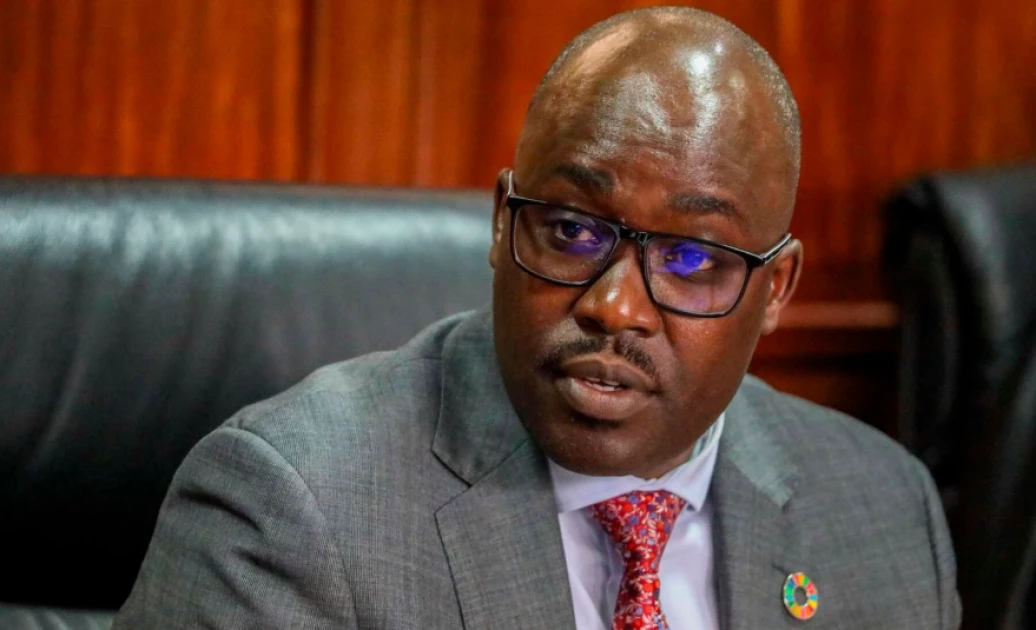
Foreign Affairs Principal Secretary (PS) Korir Sing’Oei has once again drawn criticism after his comments on the United Nations Security Council’s adoption of a new peacekeeping mission in Haiti sparked a diplomatic correction from Russia.
Following the UN Security Council’s September 30 approval of a new multinational Gang Suppression Force (GSF) to replace the Kenyan-led Multinational Security Support (MSS) mission, PS Sing’Oei took to X (formerly Twitter) on October 1, praising what he described as a “unanimous” decision.
“The unanimous adoption of Resolution 2793 (2025) last night by the UN Security Council is a welcome development in the pursuit of a more peaceful and secure Haiti,” he wrote.
However, Russia’s First Deputy Permanent Representative to the UN, Dmitry Polyanskiy, swiftly corrected him, noting that the resolution was not unanimously adopted.
“I have to respectfully correct our Kenyan brothers – the resolution wasn’t adopted unanimously. Russia, China, and Pakistan abstained. We didn’t block this proposal, only yielding to pleas from Latin American and African countries. But we fear the Council is being dragged into another adventure,” Polyanskiy wrote on October 3.
The exchange triggered debate back home, with observers questioning whether Sing’Oei’s statement was a simple typo or a sign of unfamiliarity with the details of the Council’s decision — a serious concern given his pivotal role in managing Kenya’s foreign relations.
Under the newly approved transition, the Gang Suppression Force will deploy up to 5,500 uniformed personnel, including both police officers and soldiers, for an initial 12-month period. The GSF will work alongside the Haitian National Police (HNP) and Haitian Armed Forces (HAF) to neutralize gangs, protect critical infrastructure, and secure humanitarian access.
The United States, a co-sponsor of the resolution, underscored the mission’s expanded scale.
Ambassador Mike Waltz stated, “With this vote, we transform the MSS mission into the new Gang Suppression Force — a mission five times larger than its predecessor, with a stronger mandate to confront gangs.”
Repeated Online Missteps Raise Questions on PS’s Judgment
This latest incident is not the first time PS Sing’Oei’s online activity has raised eyebrows. In February 2025, he came under fire after posting an AI-generated deepfake video on his official X account, falsely portraying CNN journalist Fareed Zakaria praising Kenya’s diplomatic role in Sudan’s peace process.
The video, crafted to resemble an authentic CNN broadcast, was soon flagged as fake by online users. Facing mounting criticism, Sing’Oei issued an apology:
“I sincerely apologize for inadvertently posting an AI-generated video disguised as a genuine commentary from Fareed Zakaria on the Sudan peace search and Kenya’s role. I regret any confusion caused and thank everyone who flagged the deepfake.”
A year earlier, in October 2024, Sing’Oei had also defended the government’s controversial decision to repatriate four Turkish nationals, a move widely condemned by international human rights bodies.
The PS justified the deportations as serving the “greater good,” arguing that Kenya had to balance diplomatic principles with its foreign partnerships. He insisted the four faced serious treason-related charges and that repatriating them was necessary to avoid interference in Turkey’s internal affairs.
However, rights groups including the International Commission of Jurists and Amnesty International criticized the decision, warning that Kenya’s action risked exposing the individuals to political persecution or even execution upon return.
As scrutiny mounts over his recent statements, analysts suggest PS Sing’Oei must exercise greater caution in official communications, especially on international platforms where diplomatic precision is crucial.