Uganda’s richest men in 2026 collectively control more than 10.3 billion dollars in estimated private wealth. In a 65 billion dollar economy, that concentration is material. Moreover, it highlights how capital accumulation in Uganda has outpaced the development of formal financial markets.
Unlike more mature economies where listed equities dominate wealth portfolios, Uganda’s capital markets remain relatively shallow. As a result, Uganda’s richest men in 2026 have largely built their fortunes through privately held enterprises, commercial real estate, petroleum distribution and industrial platforms. Consequently, tangible asset ownership, rather than financial leverage, defines the structure of economic power.
At the same time, per capita income remains modest and a significant share of economic participation is informal. Therefore, the divergence between aggregate capital accumulation and household prosperity remains visible. Against this backdrop, the following ranking provides an asset-based overview of the country’s most prominent wealth holders. All figures are indicative estimates rather than audited disclosures.
1. Hamis Kiggundu – ~US$1.35 Billion
Among Uganda’s richest men in 2026, Hamis Kiggundu occupies the top position. His wealth is primarily anchored in high-density commercial real estate across Kampala. Over successive development cycles, he has reinvested rental cash flow into mixed-use towers and shopping complexes.
In addition, strategic land banking across multiple regions enhances long-term appreciation potential. Meanwhile, beverage manufacturing operations introduce industrial exposure beyond property income. Furthermore, fintech participation through Hamz Pay connects part of his portfolio to digital transaction growth.
Notably, reported international holdings provide geographic diversification. Consequently, his capital structure reflects both domestic asset dominance and measured external exposure.
2. Sudhir Ruparelia – ~US$1.2 Billion
Similarly, Sudhir Ruparelia represents one of the most diversified structures among Uganda’s richest men in 2026. Through the Ruparelia Group, his capital base spans commercial real estate, hospitality, insurance, education and floriculture exports.
Commercial property provides long-term balance-sheet stability. However, hospitality assets such as Speke Resort Munyonyo introduce exposure to tourism cycles. At the same time, insurance and education generate steady institutional cash flow. Therefore, his portfolio balances cyclical revenue with predictable income streams.
3. John Bosco Muwonge – ~US$850 Million
In contrast to diversified conglomerates, John Bosco Muwonge maintains a concentrated property model. His holdings across central Kampala corridors generate recurring rental income tied to retail density and foot traffic.
Because prime inner-city land remains scarce, valuation benefits from structural supply constraints. As a result, tenant turnover and occupancy stability directly influence capital performance.
4. Drake Lubega – ~US$800 Million
Likewise, Drake Lubega’s wealth is predominantly property-driven. Through Jesco Industries Limited, he has accumulated arcades and mixed-use developments in high-footfall trading zones.
While industrial warehouses and education assets add modest diversification, commercial real estate remains the core valuation engine. Consequently, occupancy rates and retail demand cycles significantly impact portfolio stability.
5. Mansour Matovu – ~US$785 Million
Initially building capital through logistics and motorcycle imports, Matovu later transitioned into commercial property development. Since then, arcades such as MM Plaza have generated steady rental income.
Therefore, his capital structure illustrates how early trade profits can be converted into long-term asset-backed stability.
6. Karim Hirji – ~US$785 Million
Meanwhile, Karim Hirji blends hospitality, automotive distribution and real estate under the Dembe Group. The Imperial Hotels portfolio positions him within the tourism economy. However, hospitality revenue remains sensitive to macroeconomic cycles.
Consequently, ownership of Cham Towers provides asset-backed balance-sheet anchoring that offsets demand volatility.
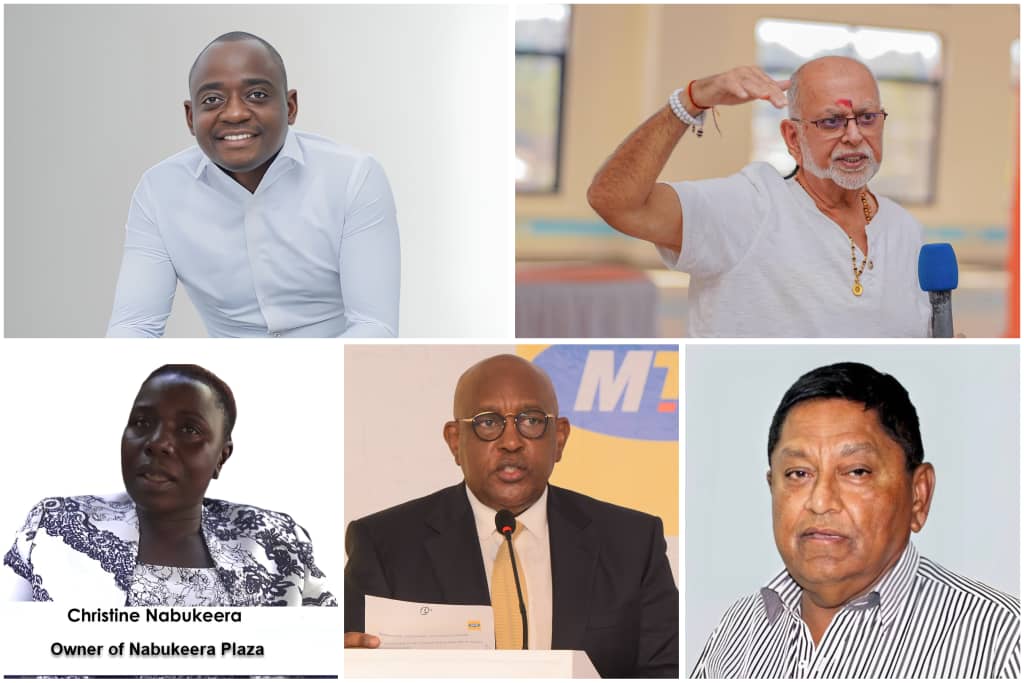
7. Christine Nabukeera – ~US$710 Million
Notably, Christine Nabukeera’s wealth is concentrated in premium commercial and residential property. Investments such as New Pioneer Mall reflect disciplined land acquisition strategies.
Although property cycles can fluctuate, high-demand urban locations provide long-term appreciation resilience.
8. Tom Kitandwe – ~US$700 Million
Over three decades, Tom Kitandwe transitioned from trade-based capital formation into commercial real estate development. As a result, his properties in key trading intersections now generate consistent rental income.
In addition, agribusiness land and telecommunications-linked investments introduce diversification. Nevertheless, real estate remains the primary valuation anchor.
9. Guster Lule Ntake – ~US$670 Million
In comparison with property-heavy peers, Ntake’s structure is more industrially diversified. Hospitality assets generate service-sector income, while manufacturing and food processing create value-added production exposure.
Therefore, his portfolio blends operational revenue with land-backed stability.
10. Godfrey Kirumira – ~US$615 Million
Kirumira’s wealth originates in petroleum distribution. Fuel retail generates recurring liquidity tied to transport demand. However, margins remain exposed to oil price volatility.
To mitigate that risk, he has diversified into commercial real estate and telecommunications infrastructure. Consequently, his capital model combines operational turnover with asset-backed preservation.
11. Charles Mbire – ~US$600 Million
Unlike land-dominant magnates, Charles Mbire represents the equity-driven segment of Uganda’s richest men in 2026. His stake in MTN Uganda ties valuation to corporate earnings and dividend performance.
Furthermore, investments in energy and infrastructure expand exposure across strategic sectors. Therefore, his wealth profile remains more market-sensitive but also broadly diversified.
12. Amos Nzeyi – ~US$550 Million
Amos Nzeyi’s wealth is fundamentally industrial. Crown Beverages Limited anchors valuation through production scale and consumer demand.
In addition, food production and hospitality ventures generate recurring revenue. Consequently, his capital structure reflects enterprise building rather than land accumulation alone.
13. Ahmed Omar Mandela – ~US$535 Million
Mandela’s vertically integrated model spans petroleum retail, hospitality and agro-processing. City Oil provides liquidity, while food service brands capture urban consumption trends.
Therefore, his diversification reduces dependence on a single revenue stream.
14. Haruna Sentongo – ~US$490 Million
Sentongo focuses on redevelopment-driven urban commercial property. Markets and arcades in dense trading zones generate strong tenant turnover.
As infrastructure improves, land appreciation provides additional upside.
15. Patrick Bitature – ~US$220 Million
Finally, Patrick Bitature’s capital base emerged from telecommunications distribution before expanding into energy infrastructure and hospitality.
Although infrastructure investments are capital-intensive, they offer long-term stability when regulatory frameworks remain predictable.
The Broader Capital Structure
Taken together, Uganda’s richest men in 2026 illustrate a defining structural pattern. Wealth at the top is overwhelmingly anchored in tangible assets. Commercial property dominates. Petroleum distribution follows. Manufacturing and telecom equity complete the hierarchy.
Moreover, access to land, scale financing and distribution networks creates high entry thresholds. Consequently, capital concentration compounds faster than wage-based wealth accumulation.
As Uganda advances toward oil production and deeper digital integration, the structure of private capital may gradually evolve. However, for now, ownership of physical income-producing assets remains the central engine of wealth formation in Uganda.
READ: Gold Prices Fall as Dollar Gains and Trump Tariffs Loom