The 2026 Africa conflict watchlist serves as a vital early warning system. It identifies emerging crises that could soon demand U.S. military, diplomatic, or humanitarian responses. Published by the Council on Foreign Relations, the survey assesses each risk based on likelihood and severity. Therefore, it aims to guide policymakers toward timely action before conflicts spiral out of control.
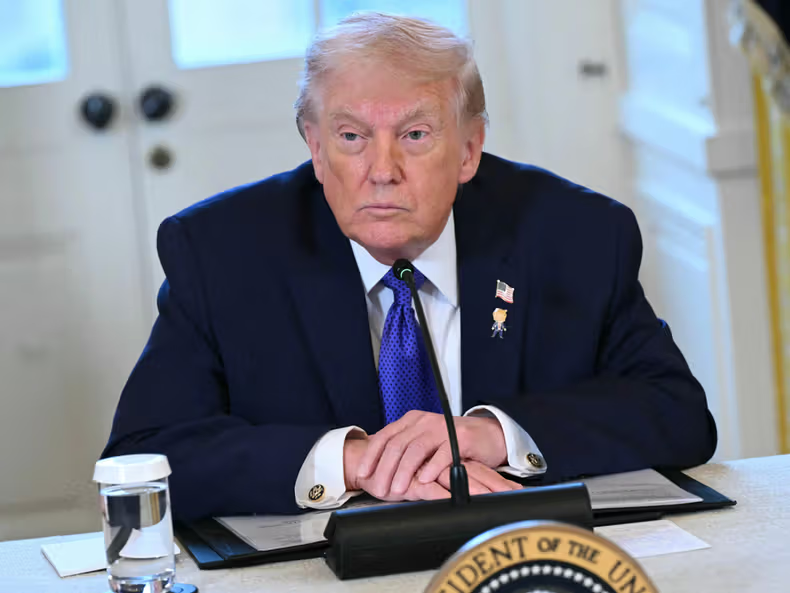
This year’s outlook arrives amid a striking policy contradiction. On one hand, the second Trump administration has pushed to end major wars in Gaza, Ukraine, and the Democratic Republic of Congo. On the other hand, it has significantly reduced funding for conflict prevention, strategic foresight, and peace-building institutions. Consequently, America’s capacity to detect and defuse brewing crises—especially in fragile regions like Africa—has weakened. Analysts warn that this reactive stance may leave the U.S. unprepared for sudden emergencies.
Several structural forces are driving instability across the continent. Notably, international security support is retreating. In Somalia and parts of the Sahel, Western military assistance has declined sharply. As a result, jihadist groups such as Al-Shabaab and ISIS affiliates are regrouping. They exploit weak governance, porous borders, and poorly equipped national armies. Moreover, these militants are expanding their influence into coastal West African states like Benin, Togo, and Côte d’Ivoire.
In addition to security vacuums, election-related tensions pose serious risks. For instance, in South Sudan and the Democratic Republic of the Congo, delayed or contested elections could reignite ethnic and political rivalries. These disputes often intertwine with elite power struggles and competition over natural resources. Oil, gold, and critical minerals—essential for global energy transitions—are frequent flashpoints. Thus, resource-driven violence continues to fuel armed conflict in Sudan, eastern Congo, and northern Mozambique. Illicit extraction networks and foreign commercial interests further complicate efforts to restore peace.
Sudan remains one of the most urgent cases on the Africa conflict watchlist. Its civil war between the Sudanese Armed Forces and the Rapid Support Forces shows no sign of abating. Mass displacement, potential atrocities, and spillover into Chad, South Sudan, and the Central African Republic are real concerns. Similarly, Somalia’s stability depends heavily on external backing. Should U.S. counterterrorism support decline further, hard-won gains against Al-Shabaab could unravel.
Nigeria also appears on the watchlist due to persistent Islamist insurgency in the northeast. Despite its regional influence, the country faces growing state fragility. Without stronger governance, insecurity could spread and deepen humanitarian pressures. Meanwhile, Mali exemplifies the broader Sahel crisis. Military rule and weak institutions have allowed insurgents to advance southward, threatening previously stable coastal nations.
The Democratic Republic of the Congo remains volatile, particularly in the east. Rwanda-backed militias continue to destabilize the region. Consequently, the Africa conflict watchlist warns of possible escalation involving neighboring countries. Ethiopia, too, faces renewed risks. Border tensions with Eritrea and strategic disputes over Red Sea access could spark fresh conflict.
Northern Mozambique presents another challenge. An Islamist insurgency there endangers civilians and jeopardizes major liquefied natural gas investments. In Cameroon, separatist violence in the Anglophone regions—combined with governance failures in the north—could widen into nationwide instability. Likewise, South Sudan’s fragile peace hangs in the balance. Delayed elections may trigger a return to ethnic and political violence.
Why does this matter to the United States? Although these conflicts do not directly threaten U.S. territory today, neglecting them now could lead to far costlier interventions later. Waiting for crises to explode wastes lives, money, and strategic influence. Proactive diplomacy, targeted aid, and support for regional peace efforts offer a more sustainable path. Ultimately, the Africa conflict watchlist is not just a forecast—it is a call for forward-looking U.S. engagement. In an era of global competition, ignoring Africa’s fragility does not save resources; it squanders them.
READ: Museveni Wins Fair Vote, Extends Uganda Rule After Election