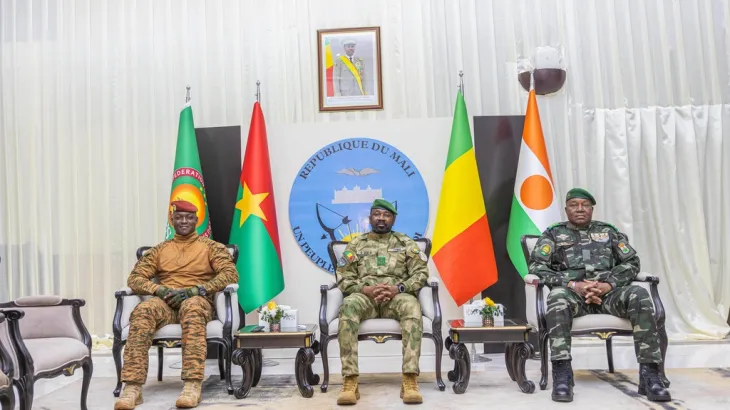
In a critical move aimed at strengthening regional security, Burkina Faso’s interim leader, Captain Ibrahim Traore, has vowed to launch “large-scale” joint operations against armed groups in the Sahel region. This comes after the recent summit of the Alliance of Sahel States (AES), a military-led coalition consisting of Burkina Faso, Mali, and Niger. These countries have been working together to bolster their sovereignty and combat the growing threat of extremist groups linked to al-Qaeda and ISIL (ISIS).
Strengthening Regional Unity Amid Rising Threats
The AES leaders, in a bold display of unity, have committed to ramping up military and security measures following years of instability. The formation of the AES represents a shift in the Sahel’s geopolitical landscape, as the three nations have distanced themselves from longtime security partners like France and the United States. Instead, the AES has sought closer ties with Russia to advance their agenda of regional self-sufficiency and sovereignty.
This week, a major milestone was achieved with the launch of the AES Unified Force (FU-AES), a 5,000-strong military unit designed to tackle insurgent groups operating across the region. The deployment of this force underscores the increasing determination of the AES members to safeguard their territories and regain control from armed factions that have destabilized much of the Sahel.
A New Era of Self-Determination for the Sahel
In his address at the summit, Traore emphasized that the region is entering a new era of independence. He expressed confidence that the AES alliance, having already withdrawn from the Economic Community of West African States (ECOWAS), would chart its own course. He also warned of the looming risks posed by external forces, describing the period as the “Black Winter” for West Africa—a phase marked by external threats, violence, and economic pressure aimed at destabilizing the region.
General Abdourahamane Tchiani, leader of Niger’s military government, also echoed this sentiment at the summit, stating that the AES had successfully “put an end to all occupation forces in our countries.” He highlighted the alliance’s resolve to assert control over its future, free from foreign interference.
The Growing Threat of Armed Groups in the Sahel
The Sahel region has been plagued by a steady rise in the activities of armed groups, particularly those aligned with al-Qaeda and ISIS. These extremist factions have exacerbated the security crisis, destabilizing the region and threatening the safety of its citizens. As part of the AES alliance’s broader strategy, the leaders have committed to confronting these groups through coordinated military operations and intelligence-sharing.
General Assimi Goita of Mali, who also attended the summit, reported significant operational successes in the battle against armed groups. He stated that “several terrorist bases” had been destroyed, marking a critical step forward in the region’s fight for stability.
In a move to combat misinformation and provide a platform for regional unity, the AES leaders also launched AES Television. The new broadcaster aims to counter the disinformation campaigns and hostile narratives that have targeted the alliance and its member states. Goita described AES Television as a strategic tool for promoting accurate information and breaking through the hostile narratives that have sought to undermine the legitimacy of the AES governments.
Economic Cooperation and Regional Development
While security remains a priority, the leaders of the AES also took steps to address the economic challenges facing the Sahel. Despite narratives that portray the region as structurally poor, the AES states are rich in natural resources, including valuable mining and agricultural potential. Goita emphasized the importance of these resources in fostering long-term economic growth and stability. The AES is committed to leveraging its collective economic strength to reduce dependency on external aid and investment, aiming to create a self-sustaining and resilient region.
The second annual AES summit highlighted the growing collaboration between Burkina Faso, Mali, and Niger, as they work to strengthen not only their military cooperation but also their economic ties. According to Ulf Laessing, head of the Sahel program at the Konrad Adenauer Foundation, the AES alliance enjoys growing popularity among the citizens of these countries. The alliance is increasingly seen as a beacon of hope for a more self-reliant and secure future.
The Future of the AES: Navigating Challenges and Opportunities
Despite the political and economic challenges facing the AES, the alliance’s efforts to foster unity and stability in the Sahel are gaining traction. The countries involved are committed to not just military cooperation but also regional development and political sovereignty. As the AES strengthens its hold on security and economic matters, it seeks to chart a path free from external influence while managing the complex dynamics of internal governance and external pressures.
With military operations ramping up and an emphasis on regional self-reliance, the AES is positioning itself as a key player in the Sahel’s future. However, the ongoing challenges posed by armed groups and regional instability will require sustained cooperation and innovative strategies to secure lasting peace and prosperity.