Madagascar’s military formally seized control of the government after Parliament voted to impeach President Andry Rajoelina. The dramatic turn of events follows weeks of large protests, military defections, and a constitutional standoff.
From Protests to Mutiny
The crisis traced back to September 25, when frustration over persistent water and electricity outages, rising costs, and perceived corruption erupted into mass demonstrations. Youth-led groups—especially those under the banner Gen Z Madagascar—pushed for accountability and structural reform.
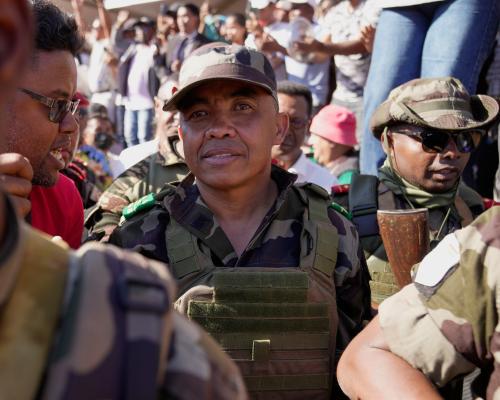
At first, the protests appeared manageable, but tensions escalated after the elite military unit CAPSAT openly sided with demonstrators. Soldiers from CAPSAT refused orders to suppress crowds and instead escorted protestors into May 13 Square, a symbolic site of prior political resistance.
As security forces splintered and the president’s support eroded, the crisis deepened. Prime Minister Ruphin Fortunat Zafisambo tried calling for calm and dialogue, but political momentum had already shifted dramatically.
The Impeachment Vote and Presidential Flight
Facing mounting pressure, Rajoelina attempted to stave off removal by issuing a decree dissolving the National Assembly. He claimed he had consulted legislative leaders, but many questioned the move’s legality.
Undeterred, Parliament proceeded with impeachment, and lawmakers overwhelmingly voted (130 in favor, one blank) to remove him from office.
Shortly after, Rajoelina fled the country, citing threats to his life. He recorded a statement via social media denying a coup, insisting the impeachment lacked legal basis, and claiming he remained the legitimate head of state.
Military Takes Over
Almost immediately afterward, Colonel Michael Randrianirina, commander of CAPSAT, announced the military had taken over. He declared that most state institutions would be dissolved—excluding the lower house of Parliament—and a transitional government would assume control for up to two years before elections.
Randrianirina claimed the takeover came in order to restore order, suspend the constitution, and prepare for a credible transition. He also pledged to hold a referendum within two years.
Soon thereafter, the military named Ruphin Zafisambo as interim prime minister, stating that a civilian government would follow.
The office of the presidency rejected the move as “illegal” and a breach of constitutional order. Rajoelina’s team asserted the country remained governed under democratic principles, despite his physical absence.
Public Response & Casualties
In Antananarivo, crowds poured into the streets, cheering the military’s announcement. Many hailed it as a victory for the people after years of misgovernance.
Yet the takeover drew wary reactions too—some voices urged caution, questioning the military’s long-term intentions and pledging to hold it accountable if promised reforms fail.
At least 22 people died, and over 100 were injured during the unrest, according to UN and local sources
Key Players: CAPSAT & Randrianirina
CAPSAT—officially the Corps d’armée des personnes et services administratifs et techniques—has long been a crucial power broker in Madagascar’s politics. Its defection marks a turning point in this crisis.
Colonel Michael Randrianirina rose through CAPSAT’s ranks and was confirmed by the High Constitutional Court as interim President following the takeover. He hails from Sevohipoty and previously held regional military commands.
Of note, CAPSAT had also played a decisive role in Rajoelina’s rise to power back in 2009 during a prior coup. This turn of loyalty underscores how volatile Madagascar’s civil-military balance remains.
Legal and Constitutional Crisis
The removal of Rajoelina triggered deep legal ambiguity. Parliament acted under impeachment powers, but Rajoelina’s dissolution order challenged its authority. The military used that constitutional deadlock to assert control.
One unresolved question is whether the lower house—left intact by the military—holds any legitimacy or power during the transition. Some view its continued existence as a nod toward preserving a civilian anchor.
Meanwhile, the High Constitutional Court and Electoral Commission were suspended. The military announced new leadership and pledged constitutional revision ahead of fresh elections.
Regional and International Reactions
The coup alarms regional bodies and global powers. France, Madagascar’s former colonial ruler, urged respect for constitutional order. President Macron called for dialogue and noninterference.
The African Union and regional blocs also expressed concern. Many reiterated that military takeovers undermine democratic norms. At the same time, some voices acknowledged the legitimacy of protest-led change.
Observers warn that unless the military transition proves inclusive and accountable, Madagascar may slide into further instability.
Challenges Ahead for the New Regime
The military faces a herculean task as it seeks legitimacy in governing. It needs to restore basic services—water, electricity, sanitation—which lie at the heart of the public’s anger.
Economic collapse, infrastructure decay, and widespread poverty will test its capacity and resolve. The new leadership must also rebuild trust across political, ethnic, and regional divides.
Another big test lies in transitioning power. Though the military has promised elections in two years, the path to those elections is fraught. Designing a fair electoral system, ensuring political participation, and resisting entrenchment will be essential.
Furthermore, the military must deliver justice for victims of the unrest and hold officers accountable for abuses. Otherwise, public support may erode.
Conclusion: A Nation at a Crossroads
Madagascar’s military takeover is dramatic, but the crisis is bigger than a coup. It reflects deep dissatisfaction with governance failures, endemic corruption, and broken institutions.
If the military follows through on its promises—returning power to civilians, drafting a new constitution, and holding free elections—then this could mark a reset.
However, if it monopolizes authority indefinitely or falters on service delivery, Madagascar may face protracted turmoil. The world will be watching whether this takeover becomes a genuine turning point—or another cycle in the island’s turbulent political history.