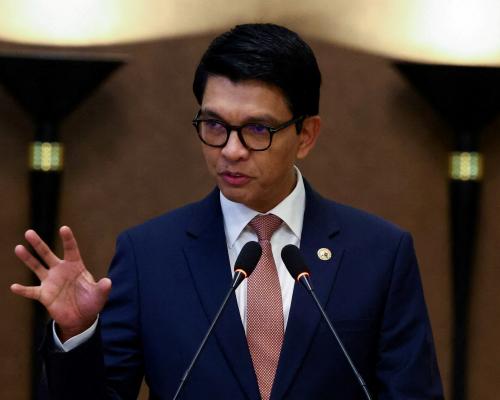
Madagascar’s political crisis deepened on Sunday as President Andry Rajoelina reportedly fled the country, according to opposition leaders, military sources, and foreign diplomats. He left amid massive anti-government protests sweeping the capital and reports that an elite military unit had defected to join demonstrators.
Rajoelina later appeared in a video message confirming that he had relocated to a “safe location” due to threats to his life. However, he firmly refused to resign, insisting that “constitutional order must stand.” He accused his opponents of attempting an illegal coup and vowed to resist any unlawful power grab.
Meanwhile, several reports suggested that Rajoelina departed aboard a French military aircraft after arriving at Sainte-Marie airport by helicopter. According to French radio station RFI, he allegedly reached a deal with French President Emmanuel Macron. Although Macron declined to confirm the details, he emphasized that France “deeply cares about constitutional order” in its former colony.
At least 22 people have died in clashes between security forces and protesters since late September, according to UN figures. Protesters claim the number could be higher, while the government disputes these reports.
What Sparked the Unrest
Initially, demonstrations began on 25 September 2025 over chronic water and electricity shortages in Antananarivo. However, they quickly evolved into a broader uprising against poverty, corruption, and poor governance. A youth-led coalition known as Gen Z Madagascar played a pivotal role, organizing through social media and uniting thousands across the nation.
As protests intensified, the elite CAPSAT unit — once instrumental in bringing Rajoelina to power in 2009 — defected. The soldiers declared they would no longer fire on civilians, effectively turning against the president. Soon after, they announced General Demosthène Pikulas as the new army chief, a move later accepted by the defense ministry, signaling a collapse in the traditional chain of command.
In response, Rajoelina dismissed his government and appointed General Ruphin Zafisambo as prime minister. Nevertheless, the public rejected this move, demanding his complete resignation instead of reshuffling his cabinet.
Effects and Immediate Risks
The president’s flight marks a critical turning point. First, it demonstrates that Rajoelina has lost crucial military support. Consequently, authority within Madagascar’s institutions is fractured, with competing factions vying for control.
Second, a dangerous power vacuum is emerging. According to the constitution, the Senate president could assume interim leadership. However, opposition figures and protest leaders are already competing for influence, which could heighten instability.
Third, security risks are escalating rapidly. The defection of armed forces increases the likelihood of internal clashes. Without a unified command structure, violence may expand beyond the capital.
Moreover, international reactions are growing. France, the African Union, and regional bodies have urged all sides to remain calm and uphold democratic norms. Nevertheless, widespread anger across the nation suggests the crisis may deepen before it stabilizes.
What Happens Next
Several key questions now dominate Madagascar’s political scene:
- Where is Rajoelina now?
Diplomatic sources are still verifying his location. His credibility will depend on whether he intends to return or remain abroad. - Who controls the state?
Power may lie with the CAPSAT unit or a temporary civilian administration. Local governors and police forces could play decisive roles in maintaining order. - Will there be a transition?
If the presidency remains vacant, the Senate president may act as interim leader. However, new elections or military rule are both possible outcomes. - How will protesters respond?
The Gen Z movement continues to push for Rajoelina’s permanent resignation and democratic reforms. The coming weeks will determine whether their momentum endures. - What will the international community do?
Regional and global actors — particularly France and the African Union — may step in to mediate. Sanctions or peacekeeping interventions remain potential measures.
Context: Rajoelina’s Rise and Decline
Andry Rajoelina first seized power in 2009 through a military-backed coup. Although he later won elections and returned to power in 2023, his rule increasingly faced criticism. Frequent power cuts, high inflation, and corruption scandals eroded his popularity. Consequently, by 2025, growing public frustration reached a breaking point.
Importantly, the very same CAPSAT unit that once supported him now turned against him — a symbolic reversal that underscores his weakened position. His recent moves to dissolve parliament and appoint military leaders appeared desperate rather than strategic, further alienating citizens.
Conclusion: A Nation at a Crossroads
In summary, Madagascar stands at a crucial juncture. The sudden departure of its president highlights the fragility of its political system and the power of public resistance. While some hope this could pave the way for democratic renewal, others fear descent into chaos.
Going forward, dialogue, restraint, and constitutional order are essential. International partners must act carefully to support stability without overriding Madagascar’s sovereignty. Ultimately, the youth-led movement that inspired this uprising must now channel its energy into building sustainable reform — ensuring that this crisis becomes a turning point toward lasting change rather than further turmoil.