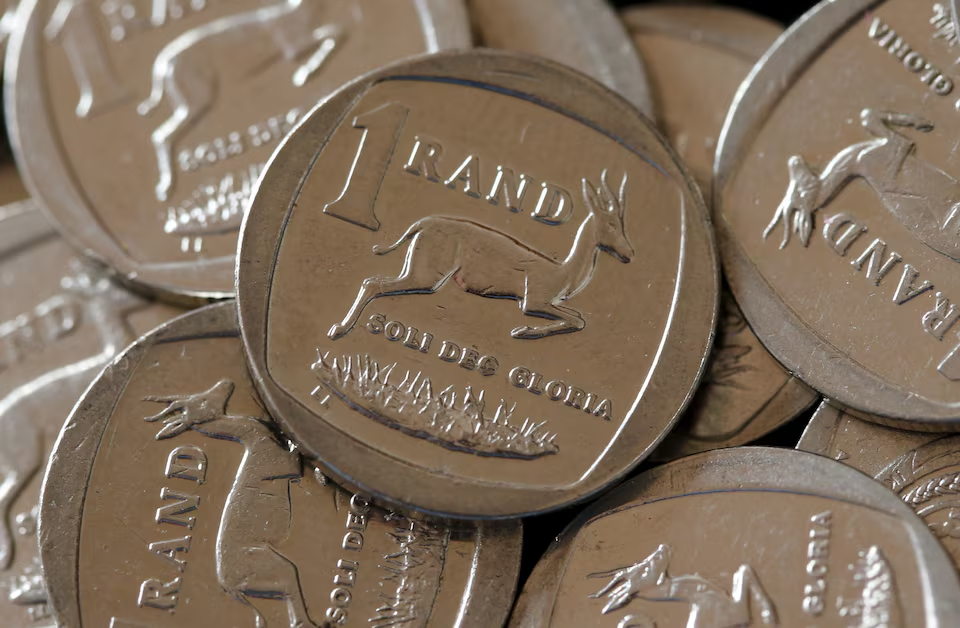
The South African rand gained slightly in early trading on Friday. Traders are looking ahead to the central bank’s interest rate decision next week. The currency traded at 16.11 against the US dollar, up about 0.1% from its previous close. This modest increase reflects cautious optimism in the market. The South African Reserve Bank will announce its decision on the main lending rate. It previously cut rates by 25 basis points in November. Consequently, this meeting will provide crucial direction for monetary policy.
This is the second meeting since the official confirmation of a new inflation target. Finance Minister Enoch Godongwana set the target at 3%, down from the previous 3-6% range. The central bank’s primary goal is to suppress inflation and anchor it at this new level. Recent data showed December inflation rose to 3.6% year-on-year, matching analyst predictions. Despite this slight increase, price pressures remain contained. Therefore, analysts still expect several interest rate cuts throughout the year.
Inflation Data and Monetary Policy Outlook
Statistics South Africa released the December inflation figures this week. Headline consumer inflation increased to 3.6% year-on-year from 3.5% in November. This minor uptick aligns with Reuters poll forecasts. The core measure, which excludes food and energy, also showed a slight rise. However, inflation remains within the historical target band and close to the new 3% goal. This environment gives the central bank room to support economic growth.
Investec chief economist Annabel Bishop explained the monetary policy committee’s focus. She stated the meeting seeks to suppress the inflation environment. Over the medium term, the goal is to embed the inflation rate at the new 3% target. Bishop noted that much depends on the inflation outlook. If it becomes embedded at the target, a sustained lower interest rate environment can follow. Market expectations are leaning towards a potential rate cut next week, or clear guidance for cuts later in the year.
Bond and Equity Market Performance
South African financial markets showed positive movement alongside the currency. The benchmark 2035 government bond gained in early trading. Its yield fell by 7 basis points to 8.185%. Lower bond yields indicate increased demand and reflect expectations for lower interest rates. This movement suggests investor confidence in the inflation trajectory and monetary policy response.
On the Johannesburg Stock Exchange, the Top-40 index rose 1% in early trade. This gain aligns with broader global market sentiment and local currency strength. A stronger rand reduces imported inflation and supports purchasing power. It also makes domestic assets relatively more attractive to foreign investors. The synchronized uptick in bonds, equities, and currency points to a favorable short-term outlook among investors.
Global Context and Currency Risk Factors
The rand’s performance does not occur in isolation. Global risk sentiment and US dollar strength significantly influence it. Recently, the dollar has shown some weakness, aiding emerging market currencies. Additionally, commodity prices, crucial for South Africa’s export income, remain relatively stable. These external factors provide a supportive backdrop for the rand.
However, domestic risks persist. Political uncertainty, exemplified by the ongoing Malema sentencing, can trigger volatility. Structural issues like power supply constraints and high unemployment also pose long-term challenges. The central bank must balance these domestic concerns with its inflation mandate. Its communication next week will be critical for maintaining market stability and guiding expectations.
Forecast for Interest Rates and the Rand
Analysts widely expect the South African Reserve Bank to begin a cutting cycle this year. The question is whether it starts next week or later. The slight inflation increase may argue for a cautious pause. However, the overall contained inflation outlook and weak economic growth support earlier easing. The bank’s statement will likely emphasize data dependency and a gradual approach.
For the rand, a rate cut could initially cause some weakness due to reduced yield appeal. Nevertheless, if cuts are seen as supportive for long-term economic health, the currency could stabilize or strengthen over time. The key will be the bank’s ability to maintain credibility on inflation while addressing growth. Traders will closely parse every word of the policy statement for clues about the pace and extent of future easing.