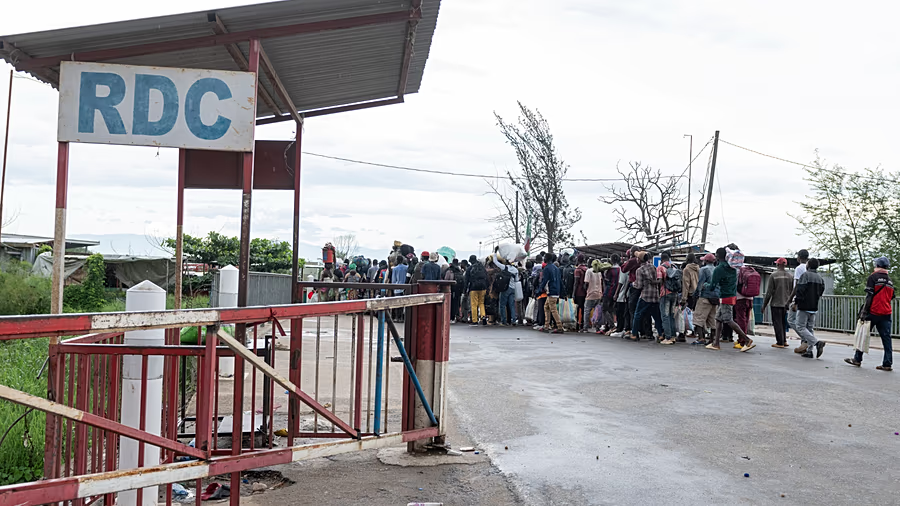
The M23 rebel group has announced its intention to withdraw from the strategic eastern city of Uvira, placing security responsibilities with the international community. This declaration, detailed in a formal statement, calls for a neutral force to protect civilians and infrastructure. However, residents greeted the news with profound skepticism and fear. Continued clashes around the city contradict the promised M23 withdrawal, leaving the population trapped between warring factions and an uncertain future.
Local civilians expressed deep concern over the ambiguous security transition. Mukuninwa Assumani Ruffin noted this was the second such announcement, undermining trust in the rebels’ intentions. Meanwhile, Muzingwa Ramazani voiced the central anxiety for many: “What worries us here in Uvira is our security. How are we going to live after the M23 leaves?” Their questions highlight the vacuum created by the proposed M23 withdrawal, with no credible force immediately ready to ensure public safety and prevent reprisals.
Continued Fighting Undermines Withdrawal Declaration
Despite the public announcement, violence persists in the Uvira territory. Reports confirm ongoing clashes between M23 fighters and Wazalendo militias. Furthermore, the rebel group seized the strategic town of Lemera just one day before its withdrawal statement. This aggressive move directly contradicts its calls for a ceasefire and a peaceful handover. Consequently, the situation on the ground remains fluid and dangerous, casting serious doubt on the sincerity of the proposed M23 withdrawal.
Civil society actor Ghislain Baraiga Kabamba confirmed the troubling reality. “They are still fighting, especially in the south-south parts of Uvira, in Makobola and other localities, and this worries us,” he stated. His comment underscores the gap between rebel rhetoric and observable military activity. This pattern creates a climate of instability where announcements are viewed as tactical maneuvers rather than genuine commitments to peace. The continued fighting suggests the withdrawal may be partial or conditional.
International Mediation and Security Gaps Criticized
Analysts have pointed to significant failures in the international peace process. Hubert Masomeko, an independent researcher, criticized the American mediation effort. He argued it secured the M23 withdrawal declaration but neglected the crucial transition phase. “Security issues regarding the city of Uvira were unfortunately not taken into account by the mediation,” Masomeko explained. This lack of planning leaves a dangerous security vacuum between the rebel exit and the deployment of any neutral force.
In a letter to UN Secretary-General Antonio Guterres, M23 political coordinator Corneille Nangaa cited ongoing threats. He listed non-signatory armed actors, including the Burundian army, the FDLR, and Wazalendo militias. By highlighting these dangers, the group attempts to justify its actions and place the onus on the international community. However, this also illustrates the complex web of armed groups that will remain active even after an M23 withdrawal, complicating any peacekeeping mission.
Official Silence Deepens Civilian Anxiety
Neither the Congolese government nor the UN stabilization mission, MONUSCO, has issued an official response. This silence amplifies civilian uncertainty about the immediate future. Without a clear plan for the city’s security, residents fear a power struggle or a security collapse. The absence of a coordinated, publicized transition protocol means the proposed M23 withdrawal could lead to more chaos, not less. This administrative vacuum is a critical failure of crisis management.
The situation in Uvira reflects the broader challenges of conflict resolution in eastern DRC. Agreements are frequently announced but poorly implemented. Military movements often contradict diplomatic statements. Civilians remain the primary victims, caught between shifting front lines and unfulfilled promises. For a genuine M23 withdrawal to bring stability, it must be verifiable, complete, and followed by the rapid deployment of a legitimate security force trusted by the population.
The Path Ahead for Uvira and Eastern DRC
The immediate need is for a credible and armed neutral force to deploy without delay. MONUSCO or a regional brigade must step in to secure the city and its surroundings. Simultaneously, diplomatic pressure must ensure the M23 withdrawal is full and permanent, not a tactical repositioning. The Congolese government must also articulate a clear plan for restoring state authority in Uvira. This includes police deployment and humanitarian access.
Long-term stability, however, requires addressing the root causes of the conflict. This includes governance, resource sharing, and the disarmament of all militias. The current crisis in Uvira is a critical test for both regional and international actors. Their response, or lack thereof, will signal whether a new approach to peace in eastern Congo is possible. For now, the people of Uvira wait in fear, hoping the announced M23 withdrawal translates to real safety, not just more empty words.