Maseru — The United States plans to extend the African Growth and Opportunity Act (AGOA) by one year, offering a temporary lifeline to African economies heavily reliant on exports to U.S. markets, according to Lesotho’s trade minister.
AGOA, a key US Africa trade deal, grants duty-free access to American markets for African exports. Initially viewed as nearing its end following steep tariffs introduced by President Donald Trump earlier this year, the deal may now continue beyond its scheduled September 30 expiry.
Lesotho’s Minister of Trade, Industry and Business Development, Mokhethi Shelile, said the extension was discussed during meetings with U.S. officials from the House Ways and Means Committee and the Senate Finance Committee. “They all agreed that AGOA has to be extended and promised us that by November or December at the latest, it will be extended by a year,” Shelile told reporters.
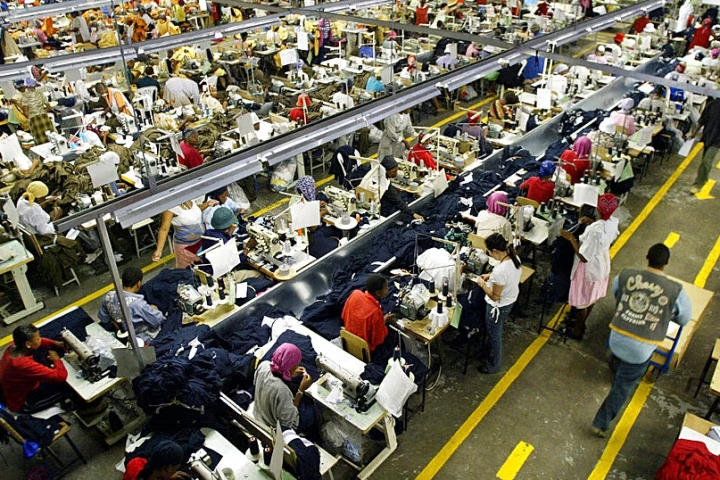
The announcement follows months of uncertainty. In April, the Trump administration imposed sweeping tariffs on global partners, with Lesotho initially facing a 50% tariff on its textile exports — a devastating blow for an economy dependent on selling denim jeans and T-shirts to the U.S. The tariff was later reduced to 15% in August.
Lesotho’s delegation to Washington, held from September 15–19, emphasized the stakes: without AGOA’s renewal, thousands of jobs in the country’s textile sector would be at risk. The kingdom’s economy is almost entirely driven by export-led manufacturing, with U.S. goods and services trade with Lesotho totaling $276 million in 2024, up 4.6% from a year earlier.
While Democrats on the Senate Finance Committee, led by Oregon Senator Ron Wyden, remain supportive of AGOA, the Trump administration has not formally confirmed its position. A White House spokesperson declined to comment.
Businesses and labor groups warn that even a brief delay in renewing the deal could trigger factory closures across Africa. “We will be monitoring closely that the extension comes into force as promised, because if it doesn’t, we are risking losing more jobs,” Shelile said.
For Lesotho and other African economies, the one-year extension may buy time, but it also highlights a broader question: what comes next for U.S.-Africa trade relations in an era of shifting global policies and intensifying competition from China and Europe?