The United States House of Representatives has passed a decisive three-year extension of the African Growth and Opportunity Act. This critical trade program provides duty-free access to U.S. markets for eligible sub-Saharan African nations. The Monday vote saw strong bipartisan support, passing 340 to 54. The legislation now advances to the Senate for further debate and a final vote. However, the continued inclusion of South Africa, one of AGOA’s largest beneficiaries, remains under a significant cloud due to escalating geopolitical tensions.
AGOA has been a cornerstone of U.S.-Africa trade policy since its inception in 2000. The program supports economic growth and development across the continent. The newly passed House bill proposes a clean, three-year AGOA extension for most current participants. This move provides much-needed certainty for African exporters and American businesses. Yet, the path for South Africa within the program appears notably less clear. Congressional scrutiny focuses on Pretoria’s foreign policy alignments, which some U.S. lawmakers view as adversarial.
South Africa’s AGOA Eligibility Faces Senate Scrutiny
South Africa’s relationship with the current U.S. administration has deteriorated markedly. Officials have previously accused Pretoria of internal policies targeting white citizens. More recently, South Africa’s foreign engagements have drawn fierce criticism. Notably, its participation in joint naval exercises with China, Russia, and Iran has alarmed key members of Congress. Although Pretoria later requested Iran’s withdrawal from the drills, the diplomatic damage was already substantial. These actions have framed South Africa as aligning with America’s strategic rivals.
Consequently, the Senate debate will likely involve intense discussion about South Africa’s eligibility. Senator Jim Risch, the influential Chair of the Senate Foreign Relations Committee, has taken a particularly hard line. He recently labeled South Africa an “adversary” of the United States. Risch argued that the time for business deals to bridge the geopolitical gap has passed. This sentiment suggests a faction within the Senate may push to exclude South Africa from the AGOA extension. Such a move would carry severe economic consequences.
Economic Stakes Are High for South Africa
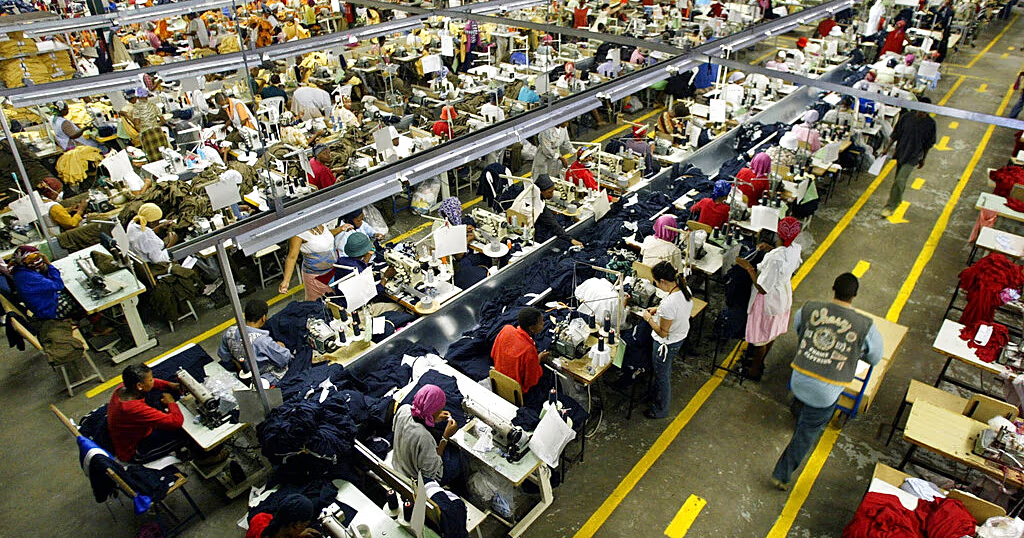
South Africa is among the top beneficiaries of the AGOA framework. The program has fueled key export industries, including automotive manufacturing, agriculture, and textiles. Loss of AGOA privileges would disrupt billions of dollars in trade and threaten thousands of jobs. For the United States, the decision carries weight beyond pure economics. It represents a test of how Washington uses trade policy to enforce foreign policy objectives. The potential exclusion of a major African economy would send a stark message about the costs of geopolitical alignment.
The Senate deliberations will therefore balance complex interests. On one side, there is a desire to maintain a unified, continent-wide trade program that fosters development and U.S. influence. On the other, there is mounting pressure to hold partners accountable for actions deemed contrary to U.S. strategic interests. The outcome is uncertain. Some senators may advocate for a compromise, perhaps a shorter-term or conditional extension for South Africa. Others may demand a full suspension to make a definitive statement.
Broader Implications for U.S.-Africa Trade Policy
The controversy over South Africa highlights a shifting landscape in U.S.-Africa relations. Trade programs like AGOA are increasingly viewed through a national security lens. The extension itself is widely supported as a vital tool for economic engagement. However, the South African case illustrates how eligibility can become leverage. This dynamic may influence the behavior of other African nations navigating relationships with both Washington and its rivals.
The Senate is expected to take up the bill in the coming weeks. Its final form will be closely watched across the continent. A clean extension for all current members would reaffirm a consistent, predictable trade partnership. Conversely, excluding South Africa would mark a dramatic politicization of the program. It would signal that market access is explicitly tied to geopolitical compliance. Either outcome will redefine the AGOA framework for its next three-year term and beyond.
Ultimately, the Senate holds South Africa’s AGOA fate in its hands. The House has acted to ensure the program’s continuation. Now, legislators must decide whether to maintain its inclusive intent or use it as an instrument of foreign policy coercion. The decision will resonate deeply in Pretoria and in capitals across Africa, setting a precedent for the future of U.S.-Africa trade relations under the AGOA extension.