Taipei, Taiwan — Taiwan chip exports to South Africa briefly became the latest flashpoint in global supply chains, after Taipei imposed restrictions this week amid a diplomatic dispute before swiftly reversing the decision.
On Tuesday, Taiwan announced export curbs on advanced semiconductors, citing a row over the diplomatic status of its office in Pretoria. The move drew immediate backlash, with South Africa’s foreign ministry accusing Taipei of seeking to “disrupt the stability of the global supply chain.” By the week’s end, Taiwan suspended the restrictions after South Africa agreed to talks, easing concerns of a broader escalation.
Officials in Taipei also faced pressure over potential market confidence risks, with reports suggesting the government feared undermining investor trust in Taiwan Semiconductor Manufacturing Company (TSMC), the world’s most important chipmaker.
The dispute traces back to 2023, when South Africa—under pressure from Beijing—requested Taiwan relocate its de facto embassy outside Pretoria. Earlier this year, South Africa set a March deadline, which Taipei ignored, escalating tensions further.
Risks for South African industries
Analysts say while the immediate fallout is limited, the auto sector remains vulnerable. “So many manufacturers in South Africa are reliant on those chip imports,” said Chris Hattingh, executive director at the Centre for Risk Analysis. The country’s growing technology sector also faces exposure if Taiwan leverages semiconductors in future disputes.
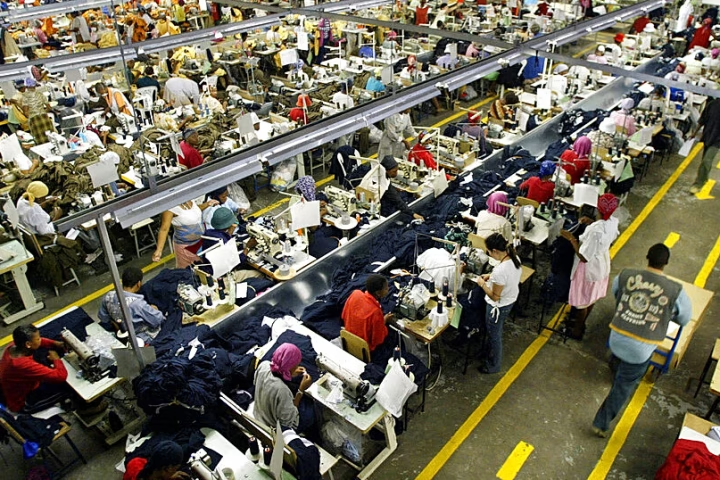
Beyond trade flows, concerns extend to the 450 Taiwanese-owned factories in South Africa, which employ an estimated 40,000 people. A prolonged rift could place those investments under strain, according to Johannesburg-based analysts.
Political and investor implications
Menzi Ndhlovu, senior political and economic analyst at Signal Risk, notes that “the message from Taiwan is that South Africa should remember they have substantial leverage over semiconductors.” He pointed out that while Taiwan is only South Africa’s 25th largest trading partner, the nature of the goods traded—chips and electronics—makes them difficult to substitute.
The episode comes as South Africa faces broader foreign policy headwinds. Relations with the United States remain tense under President Donald Trump, particularly after a chaotic Oval Office meeting with President Cyril Ramaphosa in May. Business leaders have voiced frustration over Pretoria’s inconsistent diplomacy, warning it could threaten trade deals like the African Growth and Opportunity Act (AGOA).
Analysts caution that the intersection of geopolitics and trade—whether with Taiwan, China, or the U.S.—is raising reputational risks for South Africa in the eyes of global investors. For now, Taiwan’s quick reversal has avoided immediate supply chain disruption, but the episode signals how semiconductor leverage can be used as a diplomatic tool in an era of heightened global competition.